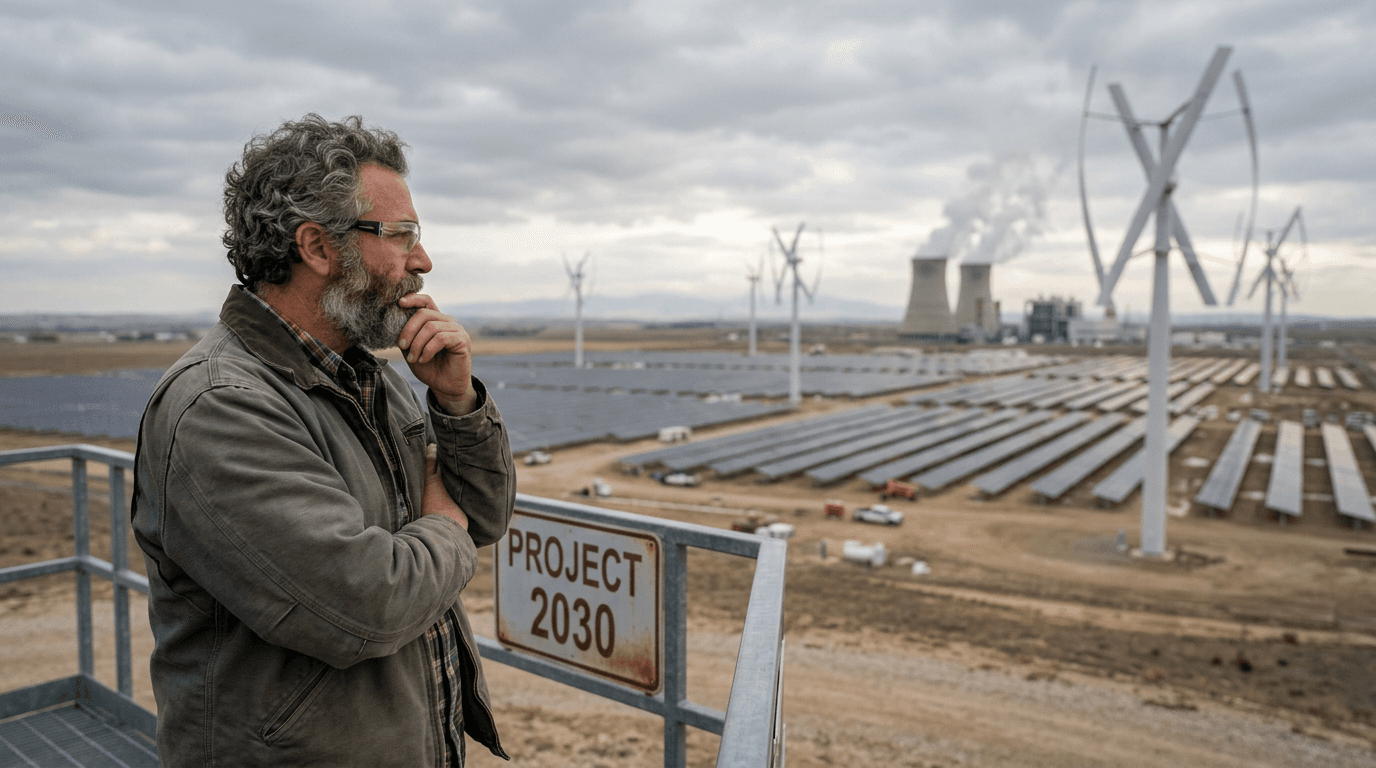
What will be the largest source of global primary energy consumption in 2030?
I've been watching a market on Kalshi that asks, "What will be the largest source of global primary energy consumption in 2030?", and I gotta tell you, the current odds are really something. The market is trading at a paltry 15% YES, meaning traders are giving a specific energy source (presumably a non-fossil fuel) a slim 1-in-7 chance of becoming the dominant energy provider in just seven short years. Conversely, that means the crowd is overwhelmingly betting 85% that one of the traditional fossil fuels – oil, natural gas, or coal – will still hold the top spot. My immediate gut reaction? That 85% NO feels pretty solid, and honestly, the 15% YES feels like an uphill battle that many might be underestimating in its sheer difficulty.
When I see a market with over 3,600 contracts traded, as this one has, it tells me there's genuine conviction on both sides, but the scale of the "NO" money is pretty clear. With over 2,300 contracts in open interest, this isn't just noise; it's a significant portion of the market agreeing that the energy transition, while rapid, won't crown a new king by 2030. And frankly, I agree with the overwhelming majority of bettors here. The inertia of our current global energy system is just immense.
Here's the thing you need to know: global primary energy consumption is currently dominated by fossil fuels. If you look at the BP Statistical Review of World Energy 2023, which covers 2022 data, fossil fuels (oil, natural gas, and coal combined) accounted for a staggering 82% of our total primary energy. Within that, oil alone was 32.8%, natural gas was 24.7%, and coal was 26.8%. All renewables – including hydro, wind, solar, geothermal, and bioenergy – collectively made up only 14.2%. Nuclear added another 4.2%. When the Kalshi question asks for the "largest source," it implies a *single* type, like oil, or natural gas, or solar, not an aggregate category like "all fossil fuels" or "all renewables." So, for something like solar or wind to individually eclipse oil or gas by 2030? That's not just a big ask; it's a gargantuan one.
I get why some people might be optimistic about the 15% YES. We see headlines daily about record-breaking solar and wind installations. The costs of these technologies have plummeted, making them competitive, and in many cases, cheaper than new fossil fuel plants. Governments worldwide are setting ambitious renewable energy targets, and innovation is pushing boundaries constantly. If you're betting YES, you're likely banking on an exponential acceleration of renewable deployment that not only outstrips growth in energy demand but also rapidly displaces existing fossil fuel infrastructure. It’s an exciting vision, absolutely.
But let's be realistic for a moment. Global energy demand is not just growing; it's growing substantially, driven by population growth and economic development, particularly in emerging economies. These countries often prioritize affordable, reliable energy to lift their populations out of poverty, and for now, that still frequently means fossil fuels. Building out new renewable capacity on the scale needed to not just add to the energy mix, but to *overtake* the existing giants individually, requires unprecedented levels of investment, grid modernization, and overcome political and logistical hurdles in less than a decade. We're talking about displacing hundreds of millions of barrels of oil equivalent per day with entirely new forms of energy generation and distribution. It's a logistical nightmare on a global scale.
Think about the projections. Even the International Energy Agency (IEA), which is deeply committed to the energy transition, paints a picture that supports the 85% NO. Their World Energy Outlook 2023, even in its "Announced Pledges Scenario" (APS) – which assumes countries meet their stated climate targets – still projects fossil fuels to account for 68% of global primary energy supply in 2030. More tellingly for this specific market, oil is still projected to be the largest *single* source in 2030 in the APS. Even in their more aggressive "Net Zero Emissions by 2050" scenario, while fossil fuel demand drops sharply, it doesn't vanish overnight, and the climb for any *single* renewable source to become numero uno by 2030 is still incredibly steep.
So, where would I put my money? If I were trading this market, I'd be buying the NO with confidence. My read is that either oil or natural gas will remain the largest single source of primary energy consumption in 2030. The sheer scale of global energy consumption, the existing infrastructure, the ongoing demand growth, and the time it takes to build out truly transformative capacity make the task of any single renewable source becoming the largest by 2030 almost insurmountable. The 15% on Kalshi reflects a bold, optimistic vision, but the 85% represents the sobering reality of energy inertia. I just don't see it happening that fast.