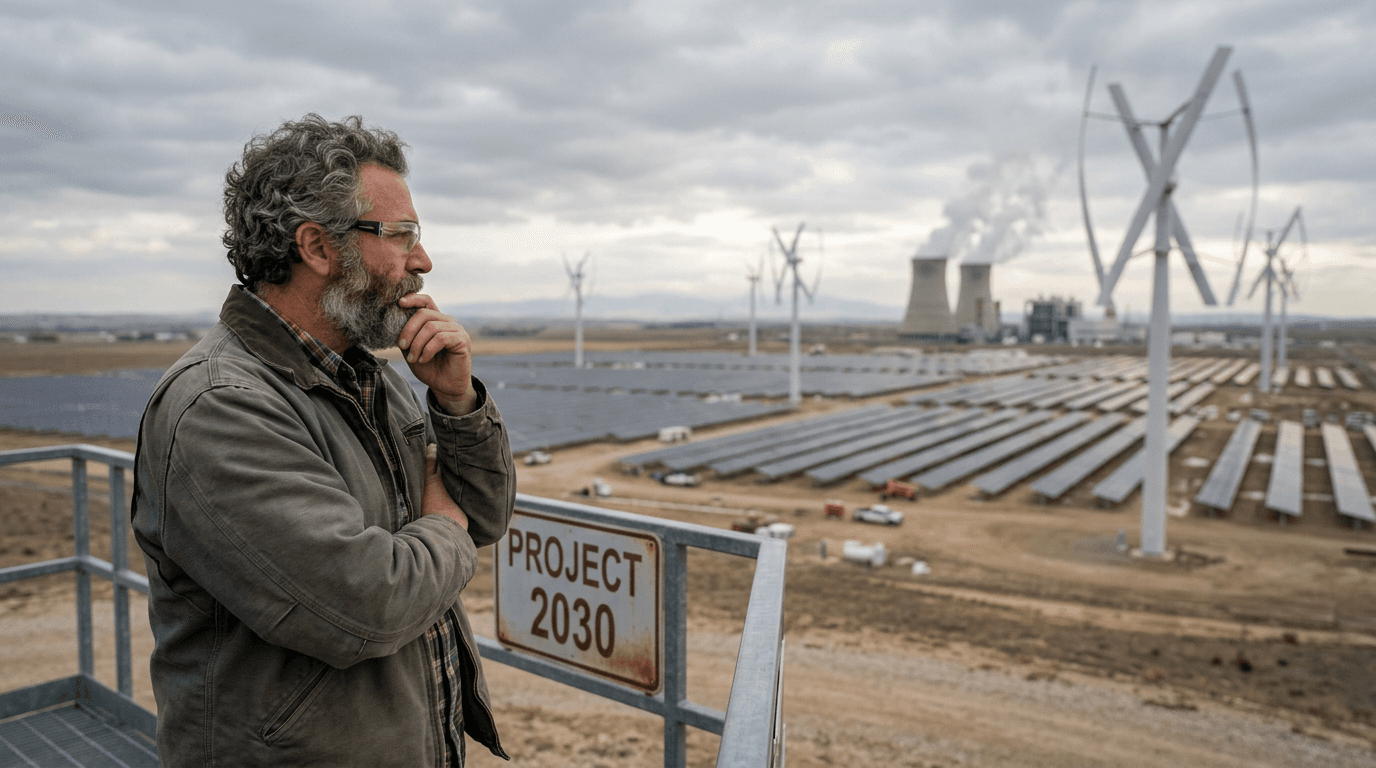
What will be the largest source of global primary energy consumption in 2030?
When I first checked the Kalshi market asking, “Will Oil be the largest source of global primary energy consumption in 2030?”, I genuinely had to do a double-take. Forty-four percent. That's the current 'YES' price, meaning traders are giving oil less than even odds – 44% to be precise – of holding onto its top spot in global primary energy consumption less than seven years from now. My gut reaction? That feels surprisingly low. But then I started digging, and suddenly, the picture isn't quite as clear as I initially thought.
This market, nestled in the climate-weather category, has seen a decent amount of action, with a trading volume of 30,574 contracts and open interest sitting at 8,114. That's a healthy number, suggesting a diverse set of opinions and real conviction behind those trades. People are actively putting money on whether oil, the undisputed king of energy for decades, will be dethroned by 2030. The 'NO' side, betting that something else will take the lead, is currently priced at a confident 56%.
For context, oil has been the single largest source of primary energy since the 1960s. Even in 2022, according to the BP Statistical Review of World Energy, crude oil and natural gas liquids accounted for approximately 31.1% of global primary energy consumption. Natural gas was close behind at 27.7%, and coal at 26.7%. Renewables, while growing rapidly, still made up a much smaller slice of the total primary energy pie.
So, what's driving this seemingly aggressive bet against oil? I think it boils down to two major forces: the relentless march of renewables and the ever-increasing pressure to decarbonize. If you've been following energy trends, you know that solar and wind power installations are absolutely exploding. The International Energy Agency (IEA) projects that renewable electricity capacity will grow by 2,400 GW between 2022 and 2027 – an amount equal to the entire power capacity of China today. That's mind-boggling scale. While electricity generation isn't the whole story of primary energy, it's a huge component, and this shift has ripple effects.
The argument for the 'NO' side (56% probability that oil *won't* be the largest) is compelling. Governments are pushing hard with policies like the Inflation Reduction Act in the US and the REPowerEU plan. Electric vehicle sales are soaring, slowly but surely eroding demand for gasoline. Many forecasters, including the IEA in its 'Stated Policies Scenario' from the World Energy Outlook 2023, predict that global oil demand will peak by 2030. If demand peaks, and alternatives continue their rapid growth, it's not a huge leap to imagine oil ceding its number one position.
But let's not discount the 'YES' side (44% probability that oil *will* remain the largest) just yet. The global energy system is a massive, incredibly complex beast with enormous inertia. It doesn't turn on a dime. While renewables are growing fast, they're starting from a lower base in terms of *total primary energy*. Developing economies, particularly in Asia, continue to drive significant demand for liquid fuels for transportation, industrial processes, and petrochemicals. Even if demand peaks, it doesn't instantly evaporate. Oil infrastructure is deeply entrenched, from refineries to pipelines to gas stations. The world still runs on a lot of oil, and switching that out entirely in just seven years is a monumental task.
Here's what I find interesting: the market isn't betting on *which* energy source will overtake oil, just that *something* will. Could it be natural gas, often seen as a 'transition fuel' from coal? Possibly. Could it be the combined force of renewables, nuclear, and hydro, considered as a single 'non-fossil' category? That seems more likely, but the question specifies "largest *source*", implying a single type. If it's a battle between Oil, Natural Gas, and Coal, then oil's 44% suggests a strong belief it will drop below natural gas, or perhaps that coal won't fall as fast as oil. It’s a subtle but critical distinction.
Personally, I think 44% for oil retaining its crown feels a touch low. I'd probably put my money closer to the 50-55% range for 'YES', acknowledging the incredible difficulty of truly displacing such a dominant incumbent in such a relatively short timeframe, even with all the tailwinds for clean energy. That doesn't mean I'm bullish on oil long-term, far from it. It just means I appreciate the scale of the challenge for alternatives to completely overhaul the energy mix. But the market has spoken, and 56% of traders are betting oil's reign will end by 2030. That's a bold prediction, and one I'll be watching very closely.
", "imageAlt": "A digital graphic showing converging lines representing different energy sources (oil, natural gas, renewables) on a timeline, with one line (oil) potentially being overtaken by another in 2030.